TR − EUR

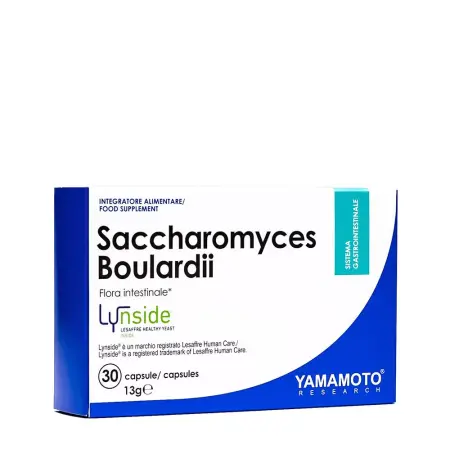
Yamamoto Research Saccharomyces Boulardii Lynside® Pro SCB (30 Capsules)
Ürün Kodu: 874MNZ2376813
Barkod: 8057639550958
EUR22,20
Daha Fazla Yamamoto Research
Daha Fazla Vitamin
FLORA INTESTINALE Your ally for preventing intestinal disorders and travelling in peace. Gluten freeLactose freePromotes the balance of intestinal flora Effective treatment of different types of diarrhoea Preventive probiotic action Clinically proven efficacy on various chronic inflammatory diseases Reduces intestinal inflammationYamamoto® Research Saccharomyces Boulardii is a food supplement of probiotics, which promote the balance of intestinal flora*. The product provides 6 billions of colony-forming units of Saccharomyces cerevisiae var. boulardii per daily dose.Saccharomyces boulardii is a non-pathogenic probiotic yeast, which exerts a direct constricting effect on many pathogens that has been used in Europe for decades in treating different types of diarrhoea. It is commonly used in the medical field to prevent diarrhoea associated with antibiotic therapy or nasogastric feeding, as well as for the treatment of acute diarrhoea in adults and children or those associated with Clostridium difficile and even chronic diarrhoea in patients with HIV infection. Among the non-bacterial probiotics, the only real efficacy confirmed for some time is Saccharomyces boulardii (Sb), being the only therapeutic yeast species whose benefit as a probiotic has been demonstrated in literature (see the Marchand and Vandenplas study, 2000). To date, over 40 clinical studies and more than 40 pharmacological studies have been published on this precious Saccharomyces boulardii (McFarland, 2010), and thanks to this availability of clinical evidence, this therapeutic yeast is recommended by the European Society of Paediatric Gastroenterology, Hepatology and Nutrition (ESPGHAN) for the treatment of all types of acute diarrhoea in children (Guarino et al, 2014).The Saccharomyces boulardii is a wild tropical yeast discovered in Indochina in 1923 by the French scientist Henri Boulard, who managed to isolate it from the peel of various tropical fruits (lychee and mangosteen) after finding that the indigenous peoples used the peel of these tropical fruits as anti-diarrhoea drugs.This peculiarity is favoured because in humans, Saccharomyces boulardii does not colonise the intestinal system permanently and already after 6-7 days from the interruption of the administration, the relative cells are no longer detectable in the faeces.Because of its not being a bacterium, its pharmacokinetic properties of absorption, metabolism, distribution and elimination are very different from the other so-called bacterial probiotics, because it passes through the intestine and is neither absorbed nor metabolised. Once administered orally, it resists the gastric environment and biliary acids, reaching the intestine alive and effective, without being absorbed reaching steady-state concentrations within 3 days, and it is eliminated within 5 days after the treatment stops.A very important feature, which is why it has been used for so long in clinical settings, is its resistance to antibiotics. Saccharomyces B. is not deactivated by antibiotic drugs and therefore can be taken at the same time, while bacteria are almost always killed (Graff et al, 2008). This is in fact why it is so commonly used just in conjunction with antibiotic therapies to prevent the diarrhoea that they cause. Another interesting feature that differentiates this yeast from its other bacterial probiotic colleagues is its surface area, which is about 10 times greater than that of bacteria. This involves some specific activities, such as competition of the substrates, and a sort of magnet effect against pathogens (Billoo et al, 2006, McFarland 2010).The clinical efficacy of Saccharomyces boulardii has been evaluated in several types of acute diseases, starting from antibiotic diarrhoea, Clostridium difficile infections, Helicobacter pylori infection, acute diarrhoea in adults and children (where it finds extensive application), diarrhoea related to enteral nutrition, the annoying diarrhoea experienced by travellers, Vibrio cholerae infection, amoebic dysentery, and various other infections. In addition, the clinical efficacy of Saccharomyces boulardii has been evaluated in several types of chronic inflammatory diseases, including very serious ones such as Crohn's disease, the most common irritable bowel syndrome, ulcerative colitis, giardiasis, amoebic colitis, and even in diarrhoea associated with HIV.It is however a fact that both in children and adults, diarrhoea is often a problem with fairly sudden onset and with a duration ranging from a few days to several weeks. Its severity then depends on its aetiology which may be a food contamination, an intoxication, a bacterial infection, or more commonly a viral (such as seasonal gastroenteritis) or parasitic infection. Also in these cases some of the different studies available were conducted to evaluate the effect of Saccharomyces boulardii in the treatment of acute diarrhoea, where the efficacy of Saccharomyces boulardii is confirmed in
Teslimat Bilgisi
1-3 iş günü içerisinde kargoya verilir.
Benzer Ürünler








Son Baktıklarınız